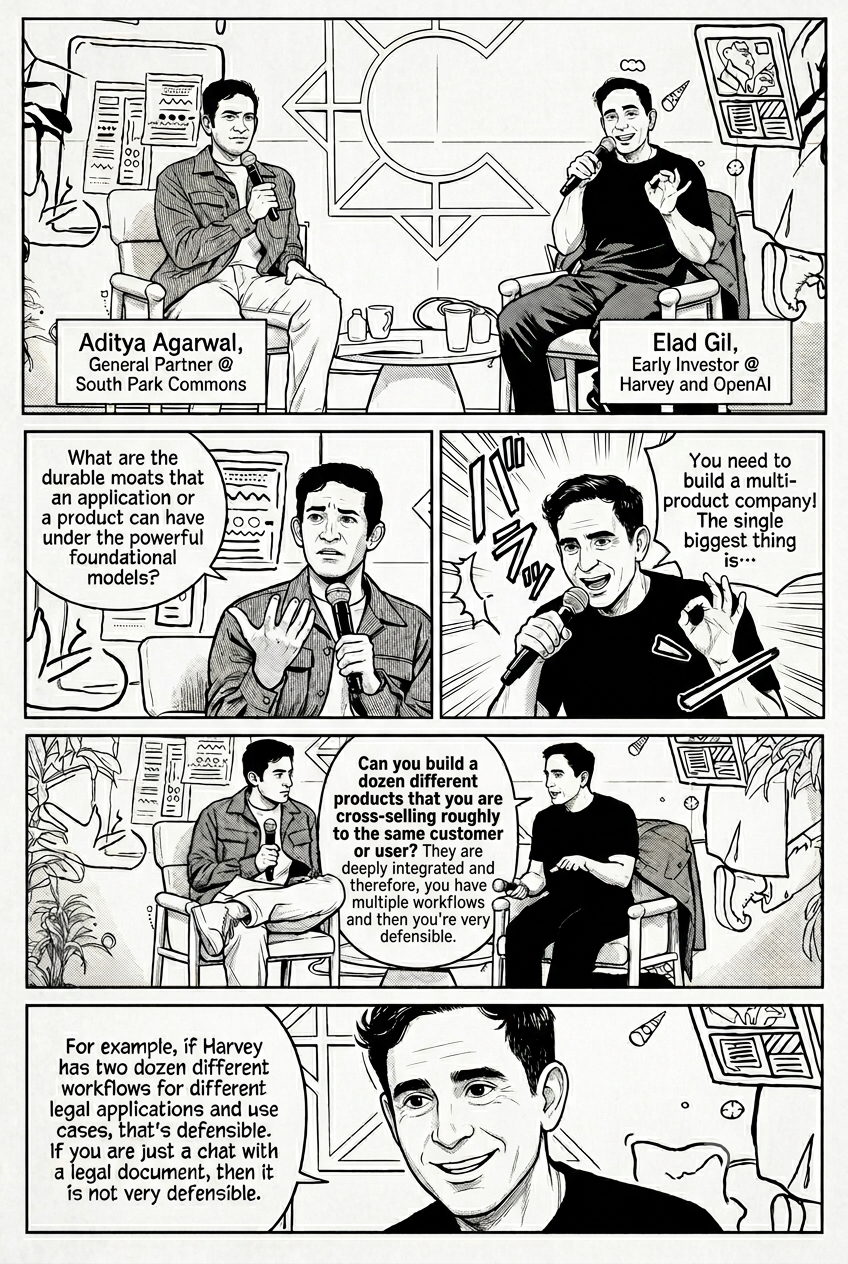
In the age of powerful foundation models, many competitive advantages that once seemed defensible are eroding fast. Features get commoditized overnight. Workflows get automated away. The question every founder should be asking is not "can we build this?" but "can we own this?"
Legendary investor Elad Gil has thought deeply about what actually constitutes a durable moat in the AI era. His answer cuts against the grain of conventional startup wisdom: the moats that survive are not the ones built on technology alone. They are built on the things that compound over time and cannot be replicated by a better model.
According to Elad Gil, durable moats in the foundation model era share a common structure. They are built from assets that get stronger as the product grows — and that a foundation model cannot simply generate from scratch:
The underlying insight is that foundation models are increasingly a commodity layer. What matters is what sits above and below that layer: the unique data flowing into it, and the distribution pulling value out of it.
Companies built purely on prompt engineering or thin wrappers around foundation models have no moat. As the base models improve, the wrapper becomes redundant. Durable businesses require the model to be one input into a larger system — not the system itself.