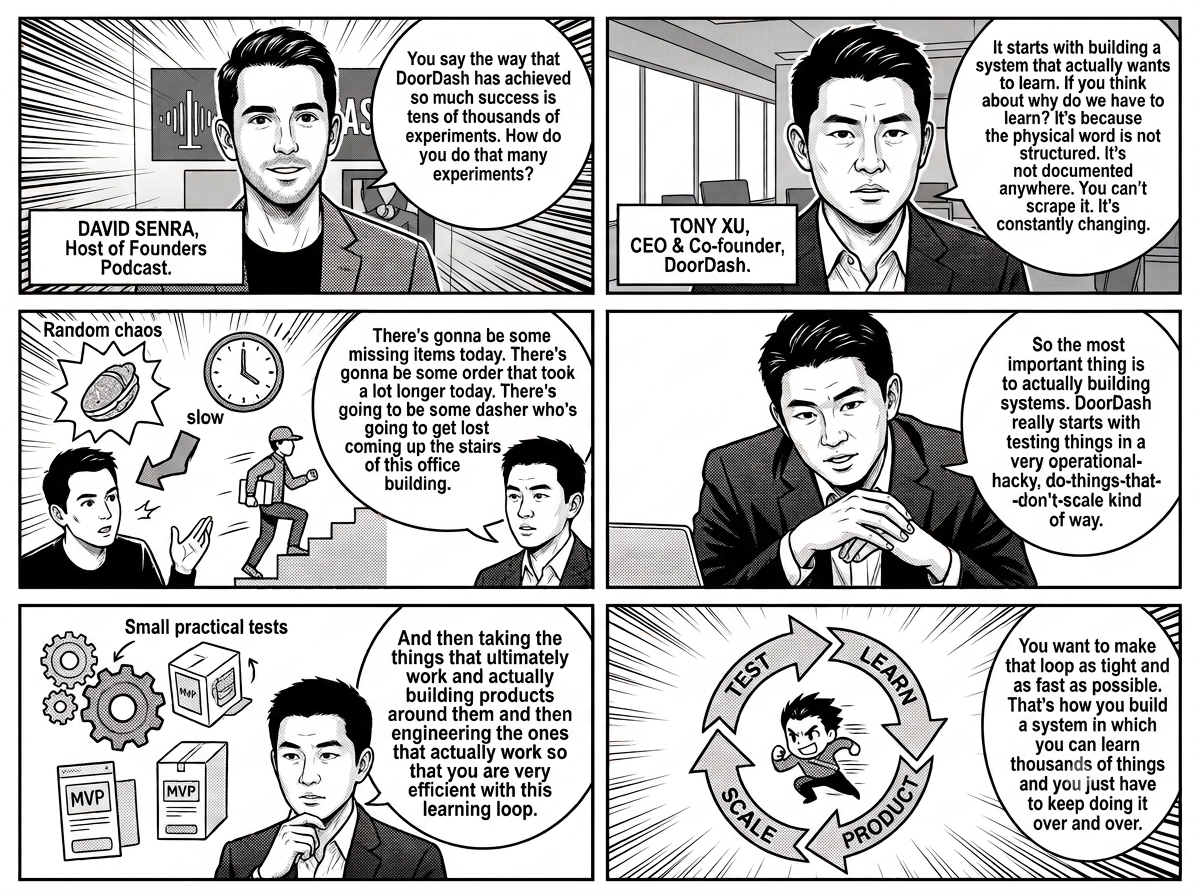
Most companies say they have a learning culture, but only a few actually do. It takes the leadership team's conscious effort to build one. DoorDash actually built one. The difference is that Tony Xu didn't treat learning as a value — he built it into the operating system of the company.
From the earliest days, Xu's thesis was simple: the company that learns fastest wins. In a marketplace with three constituencies — merchants, consumers, and Dashers — reality is always more complicated than the model in anyone's head. The only way to close the gap is to build systems that continuously surface ground truth and feed it back into decisions.
The most famous expression of DoorDash's learning culture is WeDash — a program that requires every employee, regardless of role, to make deliveries as a Dasher on a regular cadence. Engineers, product managers, data scientists, and executives all put on the red bag.
This is not a team-building exercise. It is an epistemic intervention. When you physically do a delivery, you encounter edge cases that never show up in dashboards: the restaurant entrance that's impossible to find, the customer note that gets cut off, the handoff that turns awkward in a way no metric captures. WeDash is a systematic mechanism for turning implicit field knowledge into explicit organizational knowledge.
Xu's insight was that data tells you what is happening but almost never why. The why lives in the experience. To build systems that actually work, you need a constant influx of people who have lived the experience recently — not just people who have abstracted it into a spreadsheet.
Underneath WeDash is a broader learning architecture that Tony Xu installed at DoorDash. It operates as a three-part loop:
What makes this loop powerful is its cadence. Learning at DoorDash is not a quarterly retrospective — it is a weekly, sometimes daily, process embedded into how teams operate.